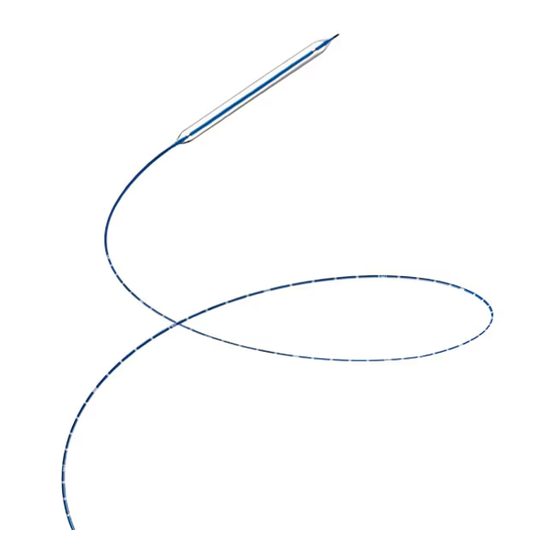
BD Ultraverse 035 Gebrauchsanweisung
Pta-dilatationskatheter
Inhaltsverzeichnis
Verfügbare Sprachen
Verfügbare Sprachen
Quicklinks
PTA Dilatation Catheter
ENGLISH
INSTRUCTIONS FOR USE
CAUTION: Federal (U.S.A.) law restricts this device to sale by or on the order of a physician.
Information in the Instructions for Use (IFU) should be discussed with the patient, at the
discretion of the physician.
Device Description
The Ultraverse
035 PTA Dilatation Catheter is a semi-compliant balloon catheter
™
consisting of an over the wire (OTW) catheter with an angioplasty balloon fixed at the
distal tip. Two radiopaque markers delineate the working length of the balloon and
aid in balloon placement. The catheter also includes a radiopaque, atraumatic tip.
GeoAlign
™
Marker Bands are designated on the catheter shaft by 1cm increment bands
with an accuracy within ±1mm. The distance from the distal balloon tip is labeled in
10cm increments. Thicker bands denote the midway point (5cm) between the labeled
distances. GeoAlign
™
Marker Bands are designed to be used as a tool to externally
measure the intravascular advancement and/or retraction of the catheter. This can
provide an intravascular reference regarding the location of the distal tip of the catheter
or an approximate intravascular length measurement between two points. GeoAlign
Marker Bands are also designed to be used as a guide to assist with geographic
alignment when used with an adjunctive therapy that utilizes the same GeoAlign
Bands. The Ultraverse
035 PTA Dilatation Catheter is compatible with .035" guidewires.
™
The proximal portion of the catheter includes a female luer lock hub connected to the
catheter with a guidewire lumen and an inflation lumen. Packaged with every product is a
protective sheath that is positioned over the balloon and should be removed prior to use.
A stylet is placed into the tip of the catheter to aid in rewrap/refolding of the balloon. A
re-wrapping tool is also provided on the catheter shaft. These products are not made
with natural rubber latex.
Figure 1
Figure 1a
(Enhanced Graphic of Catheter Shaft from Figure 1)
1cm
1cm
5cm
NOTE: GeoAlign
™
Marker Bands are non-radiopaque and designed to be utilized outside
the introducer sheath/guide catheter. GeoAlign
that may not be an exact representation of the actual distance traveled intravascularly
and should be confirmed under fluoroscopy.
Ultraverse
035 PTA Dilatation Catheter provides a clinical benefit with its ability to dilate
™
stenoses of the peripheral vasculature through a wide range of sizes (diameter/length).
Indications For Use
The Ultraverse
035 PTA Dilatation Catheter is intended to dilate stenoses in the
™
peripheral arteries, to treat obstructive lesions of native or synthetic AV fistulae and/
or re-expand endoluminal stent graft elements in the iliac arteries. This device is also
recommended for post-dilatation of balloon expandable and self-expanding stents in the
peripheral vasculature. This catheter is not for use in coronary arteries.
Contraindications
None known.
Warnings
1. Contents supplied STERILE using ethylene oxide (EO). Non-Pyrogenic. Do not
use if sterile barrier is opened, damaged, or contamination is evident. Do not
reuse, reprocess or resterilize.
2. This device has been designed for single patient use. Reusing this medical
device bears the risk of cross-patient contamination as medical devices –
particularly those with long and small lumina, joints, and/or crevices between
components – are difficult or impossible to clean once body fluids or tissues
with potential pyrogenic or microbial contamination have had contact with the
medical device for an indeterminable period of time. The residue of biological
material can promote the contamination of the device with pyrogens or
microorganisms which may lead to infectious complications. Additionally,
re-use and/or repackaging may compromise the structural integrity and/or
material and design characteristics of the device, which may lead to device
failure, and/or lead to patient injury.
™
™
Marker
10cm
™
Marker Bands provide an approximation
3. Do not resterilize. After resterilization, the sterility of the product is not
guaranteed because of an indeterminable degree of potential pyrogenic or
microbial contamination, which may lead to infectious complications. Cleaning,
reprocessing, and/or resterilization of the present medical device increases the
probability that the device will malfunction due to potential adverse effects on
components that are influenced by thermal and/or mechanical changes.
4. To reduce the potential for vessel damage, the inflated diameter and length
of the balloon should approximate the diameter and length of the vessel just
proximal and distal to the stenosis.
5. When the catheter is exposed to the vascular system, the location of the
balloon should be confirmed while under high quality fluoroscopic observation.
Do not advance or retract the catheter unless the balloon is fully deflated. If
resistance is met during manipulation, determine the cause of the resistance
before proceeding. Applying excessive force to the catheter can result in tip
or catheter breakage, catheter kink, or balloon separation.
6. Do not exceed the RBP recommended for this device. Balloon rupture may
occur if the RBP rating is exceeded. To prevent over pressurization, use of
a pressure monitoring device is recommended.
7. After contact with blood or use, this product is a biohazard. Handle and
dispose of as a biohazard in accordance with acceptable medical practices
and applicable local, state, and federal laws and regulations.
Precautions
1. Carefully inspect the catheter prior to use to verify that catheter has not been
damaged during shipment and that its size, shape, and condition are suitable for
the procedure for which it is to be used. Do not use if product damage is evident.
2. Ultraverse
035 PTA Dilatation Catheter shall only be used by physicians
™
experienced in the performance of percutaneous transluminal angioplasty.
3. The minimal acceptable introducer sheath French size is printed on the package
label. Do not attempt to pass the PTA catheter through a smaller size introducer
sheath than indicated on the label.
4. Use the recommended balloon inflation medium (25% contrast medium/75% sterile
saline solution). It has been shown that a 25%/75% contrast/saline ratio has yielded
faster balloon inflation/deflation times. Never use air or other gaseous medium to
inflate the balloon.
5. If resistance is felt during post procedure withdrawal of the catheter through the
introducer sheath/guide catheter, determine if contrast is trapped in the balloon with
fluoroscopy. If contrast is present, push the balloon out of the introducer sheath/guide
catheter and then completely evacuate the contrast before proceeding to withdraw
the balloon.
6. If resistance is still felt during post procedure withdrawal of the catheter, it is
recommended to remove the balloon catheter and introducer sheath/guide catheter
as a single unit.
7. Do not continue to use the balloon catheter if the catheter shaft has been bent or kinked.
8. Prior to re-insertion through the introducer sheath/guide catheter, the balloon should
be wiped clean with gauze and rinsed with sterile normal saline.
9. Balloon re-wrapping should only occur while the balloon catheter is supported with
a guidewire or stylet.
10. GeoAlign
™
Marker Bands are designed to be used as an additional tool to accompany
the interventionalist standard operation procedure. The use of fluoroscopic imaging
is recommended following positioning of the catheter to the target lesion and prior
to balloon deployment.
Potential Adverse Reactions
The complications that may result from a peripheral balloon dilatation procedure include:
• Additional invasive surgery
• Additional non-invasive surgery
• Air Embolism
• Aneurysm, pseudoaneurysm
• Arrhythmias
• Excessive or uncontrollable amount
of bleeding due to vessel or tissue
injury/trauma
• Foreign Body Embolism
• Hematoma
• Hemorrhage/Bleeding
• Hemothorax
• High blood pressure/hypertension
• Hypersensitivity, allergic reaction
• Infection
Note: Users and/or patients within the European Union, should report any serious
incident that has occurred in relation to the device to the manufacturer and the competent
authority of the Member State in which the user and/or patient is established. Users
outside of the European Union should report any serious incident that has occurred in
relation to the device to the manufacturer and the regulatory authority of the country in
which the user and/or patient is established.
1
• Inflammation
• Low blood pressure/hypotension
• Pain
• Perforation of vessels
• Peripheral Arterial Ischemia
• Peripheral Arterial Occlusion –
renal or limb
• Peripheral Arterial Thrombosis –
renal or limb
• Pneumothorax
• Prolonged surgery
• Shock
• Stroke/CVA
• Vessel dissection
• Vessel spasm
Inhaltsverzeichnis

Verwandte Anleitungen für BD Ultraverse 035


Inhaltszusammenfassung für BD Ultraverse 035
-
Seite 7: Produktbeschreibung
Produkte mit langen und engen Lumina, Gelenken und/oder Spalten zwischen Komponenten – nur schwer oder gar nicht zu reinigen sind, sobald sie für einen unbestimmten Zeitraum mit Körperflüssigkeiten oder Geweben in PTA-Dilatationskatheter Kontakt gekommen sind, die evtl. mit Pyrogenen oder Mikroorganismen kontaminiert waren. -
Seite 8: Anleitung Zum Gebrauch
• Zusätzliche invasive Operation • Entzündung Dilatationskatheter nicht durchquert werden kann, einen Katheter mit kleinerem Durchmesser verwenden, um die Läsion vorab aufzuweiten, sodass der Durchgang • Zusätzliche nicht-invasive Operation • Niedriger Blutdruck, Hypotonie eines Dilatationskatheters mit besser passender Größe erleichtert wird. •... -
Seite 9: Eingeschränkte Produktgarantie
1. Den neuen Ballonkatheter auf einen Führungsdraht laden. 2. Den Ballonkatheter über den bereits positionierten Führungsdraht bis zur Einführungsstelle und durch die Einführschleuse vorschieben. Wenn Widerstand fühlbar ist, den zuvor benutzten Ballonkatheter durch einen neuen Ballon ersetzen. 3. Um die geografische Ausrichtung mit dem PTA-Dilatationskatheter vor der Dilatation zu gewährleisten, den Katheter durch die Einführschleuse/den Führungskatheter vorschieben, bis die GeoAlign ™... - Seite 53 PTA Dilatation Catheter Use-By Date Maximum Guidewire Cathéter de dilatation pour ATP Date de péremption Guide maximum PTA-Dilatationskatheter Verfallsdatum Maximalgröße Führungsdraht Catetere di dilatazione per PTA Data di scadenza Filo guida massimo Catéter de dilatación para ATP Fecha de caducidad Guía máxima PTA-dilatatiekatheter Uiterste gebruiksdatum...
- Seite 54 Do Not Resterilize Manufacturer Medical Device Ne pas restériliser Fabricant Dispositif médical Nicht erneut sterilisieren Hersteller Medizinprodukt Non risterilizzare Fabbricante Dispositivo medico No reesterilizar Fabricante Producto sanitario Niet opnieuw steriliseren Fabrikant Medische hulpmiddel Não reesterilizar Fabricante Dispositivo médico Μην επαναποστειρώνετε Κατασκευαστής...
- Seite 55 BD, o logótipo BD, GeoAlign e Ultraverse são marcas registadas da Becton, Dickinson and Company ou das suas afiliadas. ©2022 BD. Todos os direitos reservados. Το BD και τα λογότυπα BD, GeoAlign και Ultraverse αποτελούν εμπορικά σήματα της Becton, Dickinson and Company ή των συνεργατών της. ©2022 BD. Με την επιφύλαξη παντός δικαιώματος.