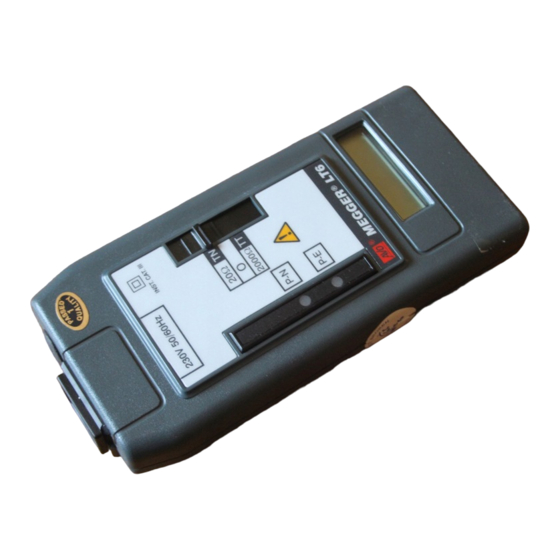
Megger LT5 Gebrauchsanleitung

Verwandte Anleitungen für Megger LT5


Inhaltszusammenfassung für Megger LT5
- Seite 1 LT5 & LT 6 Digital Loop Testers USER GUIDE GUIDE DE L’UTILISATEUR GEBRAUCHSANLEITUNG GUIA DEL USUARIO...
-
Seite 2: Safety Warnings
SAFETY WARNINGS Before carrying out an earth fault loop impedance test, confirm the continuity of protective conductors and earthed equipotential bonding. Exposed metalwork of an installation or equipment under test must not be touched. If either neon indicator fails to illuminate, switch off the supply, and check the installation wiring connections. -
Seite 3: Inhaltsverzeichnis
CONTENTS Safety Warnings Avertissement de Securite General Description Mode Operatoire Applications Hinweis Zursicherheit Operation Betriebsanweisung General warnings and precautions Aviso de Seguridad Basic procedure Instrucciones de Uso Three terminal (3-pin) socket phase-earth loop impedance test 3-phase loop impedance tests Testing bonded metalwork (conduit) Symbols used on the instrument are: Light fitting (luminaire) loop impedance tests Phase-neutral loop impedance tests... -
Seite 4: General Description
GENERAL DESCRIPTION The L T 5 and L T 6 Loop Testers are light, robust executed). They provide an automatic check of the instruments built into strong plastic cases, suitable for earth circuit continuity; show that the tester fuse is being carried in a tool-bag and able to withstand a intact;... - Seite 5 It is ranges of measurement are available, 20 important to note that, in all cases when a dual test on the LT5 and 20 and 2000 on the LT6. lead is used only the ‘ P - E’ neon will illuminate...
-
Seite 6: Applications
GENERAL DESCRIPTION APPLICATIONS The L T 5 and L T 6 Testers are designed for checking The instruments can be used to check the protective existing or newly installed wiring systems quickly and circuit continuity of each individual 3 terminal (3 pin) accurately. - Seite 7 manner, tests can be made on bonded metalwork in Power Cord earthing systems. (Alternatively the safety earth bond The power cord supplied with this instrument forms test lead may be used for this purpose). part of the measuring circuit of the instrument. The NOTE:- overall length of this lead must not be altered.
-
Seite 8: Operation
OPERATION N.B. Before use, it is recommended that the correct 5. If an unacceptable reading is obtained the operation of the instrument and lead is installation wiring should be inspected. Switch the established by performing a test on a known supply off before doing this. -
Seite 9: Basic Procedure
BASIC PROCEDURE the over-range indication appearing again, then the impedance is >200 (>2000 on L T 6 ) and is First set the range selector switch to the ‘0’ position, beyond the limits of the instrument. then connect the test lead to the recessed plug at the top of the instrument and plug the other end into a If the instrument’s protecting fuse has ruptured then socket of the wiring installation under test. - Seite 10 OPERATION After several repetitive operations the outside of the is therefore quite safe in ordinary environments. The tester case may become quite warm to the touch. sparking can be avoided by making the circuit This is normal and does not mean that a fault exists. connections before selecting the test range.
-
Seite 11: Three Terminal (3-Pin) Socket Phase-Earth Loop Impedance Test
THREE TERMINAL (3-pin) SOCKET PHASE — EARTH LOOP IMPEDANCE TEST (single phase 216 V — 253 V a.c. outlets) — see fig. 1) Connecting the Instrument 1. Connect the test lead socket to the recessed plug in the instrument. 2. Ensure that the slider switch on the instrument is set to ‘0’. -
Seite 12: 3-Phase Loop Impedance Tests
OPERATION 6. If the ‘P-E’ neon light does not illuminate, but the 3-PHASE LOOP IMPEDANCE TESTS (374 V — ‘P-N’ does, either: (i) the earth is not connected in 438 V a.c. circuits) — see fig. 2 the socket or the circuit protective conductor is Caution: never connect the instrument directly across open circuit;... - Seite 13 Connect the red prod to each phase in turn in the main switch, so making three separate tests. NOTE:— Always make the connections this way round. Reversing the polarity will give the same result but means that the instrument circuit is elevated to phase voltage above earth —...
-
Seite 14: Testing Bonded Metalwork (Conduit)
OPERATION NOTE:— Single phase equipment is tested in the same manner. TESTING BONDED METALWORK (conduit) — see fig. 3. Preparing for a Test 1.Obtain a convenient access to the supply phase connection in the circuit, somewhere adjacent to the bonding to be tested. 2.Connect the dual test lead socket into the recessed plug in the instrument. - Seite 15 NOTE:— outlet, somewhere adjacent to the bonding to be Always make the connections this way round. tested. Reversing the polarity will give the same result, 2. Connect the safety earth bond lead socket into but means that the instrument circuit is elevated the recessed plug in the instrument.
-
Seite 16: Light Fitting (Luminaire) Loop Impedance Tests
OPERATION No test will be made unless the ‘P - E’ neon light illuminates. 8. To repeat a test simply disconnect and then reconnect the prod. LIGHT FITTINGS (luminaire) LOOP IMPEDANCE TESTS — see fig. 5. The test is performed in the same way as for testing bonded metalwork after access to the light fitting terminations has been obtained. -
Seite 17: Measurement Of Prospective Fault Current
NOTE:— When the connections are made to the circuit the ‘P - E’ neon light illuminates not the ‘P - N’ one as might be expected. If the light does not illuminate the cause should be investigated. Phase to neutral tests may be performed at any point i n a n i n s t a l l a t i o n c i r c u i t —... - Seite 18 OPERATION Perform a test in the same way as the previous phase—neutral test i.e. the black prod is connected to the neutral terminal or conductor of the installation under test and the red prod is connected to the phase terminal or conductor. Select the ‘20 TN’...
- Seite 19 Fig. 7. Graph for determining prospective fault current...
-
Seite 20: Replacing The Fuses
OPERATION supplying sub-station is nearer or further away from prospective short- the installation or when the sub-station capacity is phase—neutral circuit current at increased. measurements ( ) 230 V a.c. supply (kA) When very low values of phase to neutral impedance 0,01 14,30 are obtained, an average of three or four readings... - Seite 21 Set the instrument to its 20 range first and then attempt a measurement by connecting to a reliable socket outlet. Do not select the 200 range (2000 range, L T 6). If the instrument fails to perform correctly with the replacement fuse fitted, this indicates the presence of a fault internally.
-
Seite 22: Specification
SPECIFICATION Ranges Resolution ‘20 Ω TN’ 0 –19,99 Ω 0,01 Ω ‘200 Ω TT’ 0 –199,9 Ω 0,1 Ω ‘20 Ω TN’ 0 –19,99 Ω 0,01 Ω ‘2000 Ω TT’ 0 –1999 Ω 1 Ω Accuracy (at 23 °C ± 2 °C) ‘20 Ω... - Seite 23 Protection Thermal cut-out protection will prevent overheating caused by excessive repetitive tests. Fuses 10 A 250 V ceramic H.B.C. fuse 25 x 6 mm (to BS 1362) fitted in BS 1363 plug for UK version. 10 A 440 V ceramic H.B.C. fuse 32 x 6 mm (Max. prospective overload 10 kA) fitted into instrument.
-
Seite 24: Accessories
ACCESSORIES Supplied with the instrument Part Number Mains supply lead fitted with ‘Euro-socket’ and three pin plug (to BS1363 for U.K.) 6131-970 Mains supply lead fitted with CEE 7/7 plug 6280-197 User Guide 6172-063 Zip-up carry case 6420-132 Available as optional extra Safety dual test lead with ‘Euro-socket’... -
Seite 25: Repair And Warranty
A number of independent instrument repair companies have used, and be sent for repair by suitably trained and qualified ® been approved for repair work on most Megger instruments, personnel. The protection is likely to be impaired if, for ®... -
Seite 26: Avertissement De Securite
AVERTISSEMENT DE SECURITE Avant de procéder à un test d'impédance de défaut de circuit de terre, vérifier la continuité des conducteurs de protection et de la liaison d'équipotentiel à la terre. Les parties métalliques d'une installation ou de matériel subissant les essais ne doivent pas être touchés. -
Seite 27: Mode Operatoire
MODE OPERATOIRE N o t e : Avant toute utilisation il est recommandé de 4 . Lors de l’utilisation d’un conducteur de test double s’assurer du bon fonctionnement de l’appareil et munis de contacts sondes, faire extrêmement du cordon de raccordement en procédant à une attention de toujours raccorder le contact rouge à... - Seite 28 MODE OPERATOIRE PROCEDURE DE BASE Dans le cas peu probable où l’indication ‘hors gamme’ Régler tout d’abord le commutateur de sélection de apparaît ànouveau, l’impédance est supérieure à 200 Ω (> 2000 Ω sur le L T 6) et se situe au delàdes limites gamme sur la position ‘0’, puis raccorder le conducteur de test à...
- Seite 29 pour éviter l’inconvénient que représente le signal moyen de l’un de ces jeux de conducteurs de sonore continu du vibreur). raccordement, que ce soit entre phases ou entre phase et neutre, sauf en ce qui concerne les essais MODE OPERATOIRE effectués sur les prises d’alimentation.
- Seite 30 MODE OPERATOIRE phase et neutre. Si la lampe indicatrice ‘P – E’ ne 3 . Raccorder la fiche située à l’autre extrémité du s’allume pas, aucun relevé ne s’effectue et il y a conducteur à la prise de l’installation devant être lieu de craindre qu’il existe un défaut dans le v é...
- Seite 31 7 . Si aucune des deux lampes indicatrices ne Préparation de l’essai s’allume: (i) le raccordement de phase n’est pas fait 1 . Le contacteur coupe circuit de tout matériel dans la prise ou son circuit est interrompu, ou (ii) raccordé...
- Seite 32 MODE OPERATOIRE l’appareil atteint la tension de phase au dessus du TESTS EFFE CTUES SUR L IA ISO NS EN TRE niveau de la tension de terre (ce qui peut entraîner JOINTURES METALLIQUES (conduits)– voir Fig. 3 un phénomène d’interférence affectant le relevé). Préparation de l’essai 6 .
- Seite 33 tension de terre (ce qui peut entraîner un 3 . Régler le contacteur coulissant sur la gamme de phénomène d’interférence affectant le relevé). mesure appropriée. 6 . Lorsque les connexions sont faites, la lampe Test de continuité de ci rcuit de te rre et indicatrice néon ‘P –...
- Seite 34 MODE OPERATOIRE 8 . Pour refaire un essai il suffit de déconnecter puis N O T E : raccorder ànouveau l’un des contacts sonde. Lorsque les connexions ont été établies, c’est la lampe indicatrice néon ‘P – E’ qui s’allume et non pas la lampe ‘...
- Seite 35 MODE OPERATOIRE Procédez aux tests de la même manière que pour Intensité éventuelle des l’essai précédent entre phase et neutre, c-à-d que la Relevés obtenus courants de court-circuit sonde noire est raccordée à la borne ou au conducteur entre phase et neutre pour une alimentation de neutre de l’installation àtester et la sonde rouge est 230 V CA (kA)
-
Seite 36: Remplacement Des Fusibles
MODE OPERATOIRE Il y a lieu de se souvenir que l’intensité éventuelle du de dimensions et de spécification correctes, ajuster et courant de défaut peut être sujette àdes modifications fixer le couvercle. dues aux changements des conditions sous lesquelles Régler tout d’abord l’instrument sur la gamme 20 Ω et est faite l’alimentation, par exemple lorsque la sous- faire un essai de mesure en le raccordant à... -
Seite 37: Hinweis Zursicherheit
HINWEIS ZURSICHERHEIT Vor dem Testen des Schleifenscheinwiderstands auf Erdungsstörungen müssen Schutzleiter und geerdete Spannungsausgleichsleitungen auf Durchgang überprüft werden. Freiliegende Metallteile von zu prüfenden Anlagen oder Geräten dürfen n i c h t berührt werden. Wenn eine der beiden Neonleuchten nicht aufleuchtet, muß die Stromversorgung getrennt und die Verkabelung untersucht werden. -
Seite 38: Betriebsanweisung
BETRIEB A n m e r k u n g : Vor dem Einsatz empfiehlt es sich, den darauf, daß die rote Prüfspitze grundsätzlich an die korrekten Betrieb des Instruments und des stromführende Klemme angeschlossen wird. Außerdem dürfen stromführende Schaltkreise nicht Kabels anhand einer bekanntermaßen berührt werden. - Seite 39 G R U N D V E R F A H R E N Meßbereichseinstellung “200 TN” (“200 TT” beim Stellen Sie den Bereichswählschalter zunächst in die L T 6) wiederholt werden. Im unwahrscheinlichen Fall einer Position “0”, verbinden Sie dann das Prüfkabel mit dem erneuten öberbereichsmeldung ist die Impedanz größer als 200 Ω...
- Seite 40 BETRIEB Nach Durchführung mehrerer wiederholter Tests fühlt Verfahren kann bei Herstellen der Verbindung zu sich die Außenseite des Instruments unter Umständen Funkenbildung führen. Der Funke ist auf 10 ms recht warm an. Dies ist normal und deutet nicht auf begrenzt und stellt daher in normaler Umgebung keine eine Störung hin.
-
Seite 41: Impedanzprüfung Der Phase-Erde-Schleife An Dreipoliger
Kabel wird entsprechend der Anleitung auf Seite 43 Schaltkreis offen ist; (ii) daß Phase und Erde a n g e s c h l o s s e n . miteinander vertauscht sind; oder (iii) daß alle drei Anschlüsse fehlerhaft sind. Prüfen Sie die IMPEDANZPRÜFUNG DER Verkabelung der Steckdose und nehmen Sie PHASE–ERDE–SCHLEIFE AN DREIPOLIGER... - Seite 42 BETRIEB 9 . Nach einer kurzen Zeitspanne wird eine Messung Impedanzprüfung von Erdungsdurchgang und der Impedanz der Phase–Erde–Schleife P h a s e – E r d e – S c h l e i f e ƒ durchgeführt, deren Ergebnis auf der Anzeige 4 .
- Seite 43 7 . Wenn die “P – E”–Neonleuchte nicht aufleuchtet, ist 3 . Stellen Sie den Schiebeschalter in den entweder die Erde oder die Phase unterbrochen. gewünschten Meßbereich. Wenn die beiden anderen Phasen geprüft werden und Ergebnisse liefern, bedeutet dies, daß die Impedanzprüfung von Erdungsdurchgang und Störung in der ersten Phase zu suchen ist.
- Seite 44 BETRIEB “P – E”–Neonleuchte nicht aufleuchtet, werden keine 6 . Nach Herstellung der Verbindungen sollten die Tests durchgeführt. Neonleuchten “P – N” und “P – E” aufleuchten, und nach einer kurzen Pause wird ein Schleifentest 8 . Zur Wiederholung eines Tests brauchen Sie nur durchgeführt und der Meßwert in der Anzeige einer der Prüfspitzen zu trennen und dann wieder d a r g e s t e l l t .
-
Seite 45: Messung Möglicher Fehlerströme
PHASE–NULLEITER–SCHLEIFENTESTS – vgl. vorliegen. Der Wert eines solchen Fehlerstroms wird Abb. 6 von der Impedanz des Phase–Nulleiter–Schaltkreises Die Tests werden auf ähnliche Weise wie beim bis zur Störungsstelle begrenzt und umfaßt sowohl vorherigen Drehstromtest, bei der Prüfung geerdeter Kabel als auch Versorgungstransformatoren usw. Metallteile oder der Lampenfassungen durchgeführt. - Seite 46 BETRIEB 230 Volt bis 100 A bei Annahme einer Möglicher Leistungsaufnahme von 16 kA am Verbindungspunkt M e ß e r g e b n i s s e Kurzschlußstrom bei der Netzverteilungs– und Versorgungsleitung Phase-Nulleiter (Ω) 230 V Wechselspannung φ...
- Seite 47 Trennen Sie das Instrument von jeglichen externen Schaltkreisen, legen Sie es auf die Vorderseite und entfernen Sie die Abdeckung des Sicherungsfachs nach Lösen der im Zentrum der Abdeckung befindlichen Schraube. Nehmen Sie die durchgebrannte Sicherung aus den Halteklammern, setzen Sie eine Sicherung derselben Auslegung ein und montieren Sie die Abdeckung des Sicherungsfachs.
-
Seite 48: Aviso De Seguridad
AVISO DE SEGURIDAD Antes de realizar una prueba de impedancia de bucle por fallo de conexión a tierra, confirme que siguen existiendo conductores protectores y conexiones equipotenciales a tierra. No deberá tocarse ningún armazón metálico expuesto de una instalación o equipo que se esté... -
Seite 49: Instrucciones De Uso
INSTRUCCIONES DE USO N o t a : Antes de utilizar el instrumento se recomienda la Nunca deberán tocarse tampoco los circuitos “vivos”. operación correcta del mismo y del cable, realizando 5 . Si se obtiene una lectura inaceptable, deberá una prueba en un contacto a tierra de confianza. - Seite 50 INSTRUCCIONES DE USO PROCEDIMIENTO BASICO margen “20 TN”, deberá repetirse la prueba bajo el Primero deberá ajustarse el selector de márgenes a la margen “200 TT” (“2000 TT” en LT6). En el poco posición “0”, luego conectarse el cable de prueba a la probable supuesto de que vuelva a aparecer la clavija empotrada en la parte superior del instrumento superposición de márgenes, es que la impedancia...
- Seite 51 vuelve a estar a punto para su utilización. (Se sugiere procedimiento básico tiene lugar como anteriormente, la desconexión del comprobador cuando se esté excepto que el margen deberá ser seleccionado enfriando para evitar la molestia del zumbido primero y la acción de conectar y desconectar las c o n t i n u o ) .
- Seite 52 INSTRUCCIONES DE USO Pruebas del bastidor metálico conectado 5 . Si la luz de neón “P – N” no se enciende, pero sí lo Existe un cable eléctrico especial de seguridad hace la “P – E”, es que bien: (1) el neutro no está conectado al enchufe o es un circuito abierto;...
- Seite 53 9 . Poco después se tomará una medición de la Prueba de impedancia en bucle de fase a tierra y impedancia en bucle de fase a tierra y la lectura de continuidad a tierra 4 . Conectar la punta negra al borne de tierra del aparecerá...
- Seite 54 INSTRUCCIONES DE USO la tierra o de la fase. La comprobación de las otras 3 . Ajustar el conmutador deslizante al margen dos fases y el establecimiento de una lectura para a d e c u a d o . las mismas, indica que el fallo se encuentra en la Prueba de impedancia en bucle de fase a tierra y conexión de la primera fase.
- Seite 55 encienda la luz de neón “P–E”. clavija de 3 alfileres está conectada a una alimentación eléctrica. 8. Para repetir una prueba sólo tendrá que 5 . Conectar la punta roja al bastidor metálico desconectarse una de las puntas y luego volver a conectado que ha de comprobarse.
- Seite 56 INSTRUCCIONES DE USO conectado a un borne de tierra y/o al bastidor metálico falla. Se trata de la corriente que fluirá cuando tenga del accesorio. El cable rojo está conectado al borne de lugar una condición de falla de impedancia la fase.
- Seite 57 La gráfica aparece en la etiqueta de instrucciones en corriente propia de la parte posterior del instrumento. m e d i c i o n e s cortocircuito a La tabla y la gráfica se basan en las recomendaciones fase a neutro (Ω) alimentación de establecidas por las Autoridades de Suministro 230 V C.A.
- Seite 58 INSTRUCCIONES DE USO de repuesto). Si se corta un fusible, entonces, con cuidado, se llevará a cabo el siguiente procedimiento: Desconectar el instrumento de cualquier circuito externo, darle la vuelta apoyándolo en su cara y sacar la tapa del fusible aflojando el tornillo que se encuentra en el centro y sacándolo.
- Seite 59 T +1 800 723 2861 T +33 (0)1 30.16.08.90 T +44 (0) 1 304 502101 T +1 214 333 3201 Megger products are distributed in 146 F +33 (0)1 34.61.23.77 F +44 (0) 1 304 207342 F +1 214 331 7399 countries worldwide.