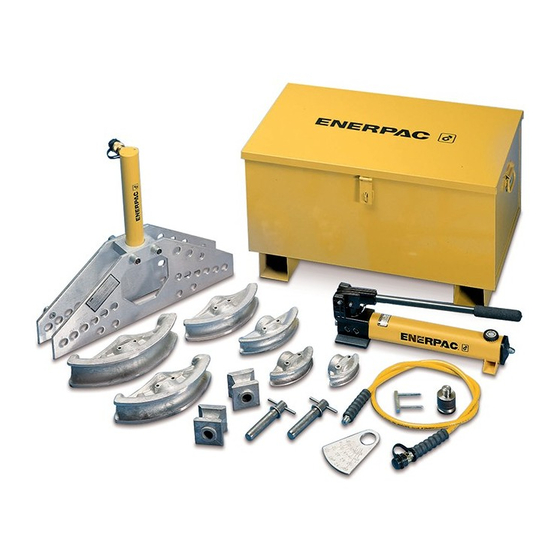
Enerpac STB Serie Arbeitsblatt
Rohrbiegevorrichtungen
Verfügbare Sprachen
Verfügbare Sprachen
L2524
Rev. O
Index:
English: . . . . . . . . . . . . . . . . . . . . . . . . . . . . . . . . . . . . . . 1-6
Français: . . . . . . . . . . . . . . . . . . . . . . . . . . . . . . . . . . . . .7-12
Deutsch: . . . . . . . . . . . . . . . . . . . . . . . . . . . . . . . . . . . .13-19
Italiano: . . . . . . . . . . . . . . . . . . . . . . . . . . . . . . . . . . . . .20-26
Español: . . . . . . . . . . . . . . . . . . . . . . . . . . . . . . . . . . . . 27-33
Nederlands: . . . . . . . . . . . . . . . . . . . . . . . . . . . . . . . . . .34-40
Portuguese: . . . . . . . . . . . . . . . . . . . . . . . . . . . . . . . . . 41-47
Repair Parts Sheets for this product are available from the
Enerpac web site at www.enerpac.com, or from your nearest
Authorized Enerpac Service Center or Enerpac Sales office.
1.0 IMPORTANT RECEIVING INSTRUCTIONS
Visually inspect all components for shipping damage. Shipping
damage is not covered by warranty. If shipping damage is found,
notify carrier at once. The carrier is responsible for all repair and
replacement costs resulting from damage in shipment.
SAFETY FIRST
2.0 SAFETY ISSUES
Read all instructions, warnings and cautions
carefully. Follow all safety precautions to avoid
personal injury or property damage during system
operation. Enerpac cannot be responsible for damage or injury
read.eps
resulting from unsafe product use, lack of maintenance or
incorrect product and/or system operation. Contact Enerpac
when in doubt as to the safety precautions and operations. If you
have never been trained on high-pressure hydraulic safety, consult
your distribution or service center for a free Enerpac Hydraulic
safety course.
Failure to comply with the following cautions and warnings could
cause equipment damage and personal injury.
A CAUTION is used to indicate correct operating or maintenance
procedures and practices to prevent damage to, or destruction of
equipment or other property.
A WARNING indicates a potential danger that requires correct
procedures or practices to avoid personal injury.
A DANGER is only used when your action or lack of action may
cause serious injury or even death.
WARNING: Wear proper personal protective gear when
operating hydraulic equipment.
WARNING: Stay clear of loads supported by
hydraulics. A cylinder, when used as a load lifting
device, should never be used as a load holding device.
After the load has been raised or lowered, it must always be
blocked mechanically.
WARNING: USE ONLY RIGID PIECES TO HOLD
LOADS. Carefully select steel or wood blocks that are
capable of supporting the load. Never use a hydraulic
®
cylinder as a shim or spacer in any lifting or pressing application.
®
11/02
Instruction Sheet
STB Series Pipe Benders
(designed for mild steel pipe only)
DANGER: To avoid personal injury keep hands and
feet away from cylinder and workpiece during
operation.
WARNING: Do not exceed equipment ratings. Never
attempt to lift a load weighing more than the capacity of
the cylinder. Overloading causes equipment failure and
possible personal injury. The cylinders are designed for a max.
pressure of 700 bar [10,000 psi]. Do not connect a jack or
cylinder to a pump with a higher pressure rating.
Never set the relief valve to a higher pressure than the
maximum rated pressure of the pump. Higher settings
may result in equipment damage and/or personal injury.
WARNING: The system operating pressure must not
exceed the pressure rating of the lowest rated
component in the system. Install pressure gauges in the
system to monitor operating pressure. It is your window to what
is happening in the system.
CAUTION: Avoid damaging hydraulic hose. Avoid sharp
bends and kinks when routing hydraulic hoses. Using a
bent or kinked hose will cause severe back-pressure.
Sharp bends and kinks will internally damage the hose leading
to premature hose failure.
Do not drop heavy objects on hose. A sharp impact
may cause internal damage to hose wire strands.
Applying pressure to a damaged hose may cause it to
rupture.
IMPORTANT: Do not lift hydraulic equipment by the
hoses or swivel couplers. Use the carrying handle or
other means of safe transport.
CAUTION: Keep hydraulic equipment away from
flames and heat. Excessive heat will soften packings
and seals, resulting in fluid leaks. Heat also weakens
hose materials and packings. For optimum performance do not
expose equipment to temperatures of 65 °C [150 °F] or higher.
Protect hoses and cylinders from weld spatter.

Verwandte Anleitungen für Enerpac STB Serie


Inhaltszusammenfassung für Enerpac STB Serie
- Seite 13 ROHRBIEGEVORRICHTUNGEN DER SERIE STB (nur für weichstahlrohre) L2524 Rev. O 11/02 Das Ersatzteilblatt für dieses Produkt finden Sie auf der Enerpac Website www.enerpac.com, oder bei Ihrem nächstgelegenen authorisierten Enerpac Service Center oder einem Enerpac Vertriebsbüro. 1.0 WICHTIGE VERFAHRENSHINWEISE FÜR DEN EMPFANG: Alle Komponenten auf sichtbare Transportschäden inspizieren.
- Seite 14 Reparaturarbeiten an die autorisierte ENERPAC- ⁄ .226 (,574) Kundendienstzentrale der jeweiligen Region wenden. Zur ⁄ (4.000) .318 (,808) Aufrechterhaltung der Garantie nur ENERPAC-Öl verwenden. .237 (,602) ⁄ WARNUNG: Abgenutzte oder beschädigte Teile (4.500) .337 (,856) unverzüglich durch ENERPAC-Originalteile ersetzen. Ausgangsmaterial: Rohr 40=Standard;Rohr 80=extra stark; Rohr 160=doppelt...
- Seite 15 Die beiden Schwenkzapfenschuhe mit der Drucktaste für die Schritt A: Biegevorrichtung Schwenkzapfenbolzen in ihrer Position verriegeln. Der Nomenklatur Schwenkzapfenbolzen wird eingeführt, indem mit dem Daumen eine Taste gedrückt und zugleich der Sterngriff Hydraulikschlauch (Biegung) erfasst wird. Die Schwenkzapfenbolzen müssen in die Hydraulikzylinder entsprechend markierten Öffnungen für die gewünschte Hydraulikschlauch (Auswurf)
- Seite 16 Einen oder beiden Schwenkzapfenschuhe entfernen und Tabelle 1, Rohrbogen 90° einen Schwenkzapfenbolzen betreffenden Nennrohr- Rücksetzmaß Mittellinien-Radius Mindestlänge (L) des Rohre "Auswurföffnung" der Rohrgröße einsetzen, so dass der größe an jedem Ende Bolzen das Rohr (nicht den Schwenkzapfenschuh) bei der der Biegemarkierung Rückbewegung hält.
- Seite 17 Die Markierungen (B) dürfen nicht näher am Rohrende Tabelle 2, Diagonalabstand (D) liegen als die Mindestlänge (L), sonst werden die Biegewinkel Biegemaß Rohrenden nicht durch die Schwenkzapfenschuhe (H) Zoll (cm) 15° 30° 45° 60° gehalten (siehe Abb. 6, Beispiel 3 und Tabelle 5 mit Mindestlänge "L").
- Seite 18 8.1 Einsatz der Gleitschuhe beim Rohrbiegen in einem Tabelle 5, Mindestlänge "L" Durchgang Rohrgröße (L) * ⁄ " (1,27) ⁄ Das gewünschte Biegemaß (H) auf dem geraden Rohr ⁄ " (1,905) ⁄ markieren (siehe Abbildung 8). 1" (2,54) ⁄ Die Größe des zu biegenden Rohres in Tabelle 6 suchen. Das ⁄...
- Seite 19 Die Gradzahl des benötigten Biegewinkels durch die Anzahl der Matrizen bzw. Biegeschritte teilen. Das ergibt die Gradzahl für jeden einzelnen Biegeschritt. (Der maximal mögliche Winkel mit den Gleitschuhen von Enerpac bei einem Biegeschritt beträgt 30°.) Den Biegeradius mit .018 und der Gradzahl pro Biegeschritt aus Schritt 2 multiplizieren (R x .018 x Gradzahl pro...