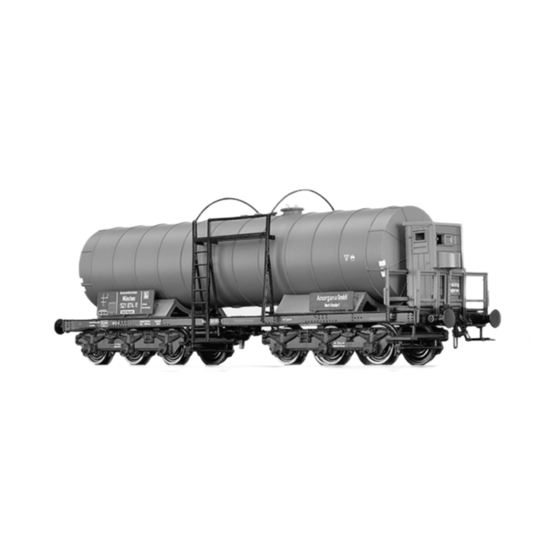
BRAWA 48520 Betriebsanleitung
Betriebsanleitung
Kesselwagen 6-achsig
Für den zunehmenden Bedarf der Rüstungsindustrie und für an-
dere kriegswichtige Transporte fertigte unter anderem H. Fuchs
Waggonfabrik A.G. in Heidelberg Anfang der Vierzigerjahre 6-
achsige Kesselwagen zum Transport von Säuren. Die Wagen
besaßen ein genietetes Untergestell, genietete Drehgestelle und
waren mit Handbremse und einer Hildebrand-Knorr-Güterzug-
bremse ausgestattet. Der Behälter war als 10-schüssige Schweiß-
konstruktion ausgeführt und hatte eine 40 mm starke Isolierung
sowie eine Heizung mit Anschlüssen am Nichthandbremsende.
Am Handbremsende war eine Übergangsbühne mit Bremserhaus angebracht. Mit einem Fassungsvermögen von knapp 40
Kubikmetern war der Kessel vergleichsweise klein. Durch die Verteilung auf sechs Achsen war jedoch die mittlere Achslast recht
gering und die Wagen konnten auch voll beladen auf Strecken mit leichtem Oberbau eingesetzt werden. Die Kessel konnten
ausschließlich von oben befüllt und entleert werden, da bei Wagen für den Säuretransport Bodenventile früher nicht zulässig waren.
Mit den Fahrzeugen, die zumeist von großen Fabriken der chemische Industrie bei der Deutsche Reichsbahn als Privatwagen
eingestellt worden waren, wurden deren Erzeugnisse zwischen den verschiedenen Standorten transportiert.
Operating Instructions
Tank Car six-axle
For the increasing requirements of the armaments industry and for other war-related transport, H. Fuchs Waggonfabrik A.G. in
Heidelberg, for example, built six-axle cars to transport acids at the beginning of the 1940s. The cars had a riveted base frame and
riveted bogies and were equipped with a handbrake and a Hildebrand-Knorr freight train brake. The tank was designed as a 10-
section welded construction and had a 40 mm thick insulation as well as heating with connections to the end without the
handbrake. At the handbrake end there was an intercommunication platform with a brakeman's cab. With a capacity of
approximately 40 cubic metres, the tank was com-paratively small. Due to the distribution over six axles, however, the mean axle
load was very low and the cars could also be used fully loaded on lines with a lighter superstructure. The tanks could only be filled
and emptied from above, as with wagons for transporting acids floor valves were not permitted in those days. With the vehicles
which were mostly used by the large factories of the chemical industry on the Deutsche Reichsbahn as private cars, their products
were transported between the various locations.
1

Verwandte Anleitungen für BRAWA 48520


Inhaltszusammenfassung für BRAWA 48520
- Seite 1 Betriebsanleitung Kesselwagen 6-achsig Für den zunehmenden Bedarf der Rüstungsindustrie und für an- dere kriegswichtige Transporte fertigte unter anderem H. Fuchs Waggonfabrik A.G. in Heidelberg Anfang der Vierzigerjahre 6- achsige Kesselwagen zum Transport von Säuren. Die Wagen besaßen ein genietetes Untergestell, genietete Drehgestelle und waren mit Handbremse und einer Hildebrand-Knorr-Güterzug- bremse ausgestattet.
-
Seite 2: Allgemeine Hinweise General Information
Radsätzen für Gleichstrombetrieb ausgeliefert. power supply. They can be exchanged for wheel-sets for AC Radsätze für Wechselstrombetrieb erhalten Sie im Tausch bei operation at your BRAWA dealer. You can also order the AC Ihrem BRAWA-Fachhändler. wheel set separately. Den Radsatz für Wechselstrombetrieb können Sie auch separat Order no.: 2187 Wheel set AC... - Seite 3 Zusatzbauteile Montieren Fitting additional parts In der Verpackung sind zusätzlich Bauteile lose beigelegt. Accessory parts have been loosely enclosed in the packaging 1 = 2x Bügelkupplung 1 = 2x Bow coupling Werden die Bauteile aus dem Zurüstbeutel für Vitrinen- If parts contained in the setting-up bag for showcase models modelle montiert, ist der Wagen nicht mehr für den are fitted, the wagon is no longer suitable for running on Fahrbetrieb geeignet.
-
Seite 4: Ersatzteile / Spare Parts
Ersatzteile Spare parts Wichtiger Hinweis: Important information: Diese Grafik gilt für mehrere Wagen-Varianten, daher können As this graphic chart is applicable to several wagon design mehr Einzelteile dargestellt sein als Sie an Ihrem Wagen versions it is possible that more individual parts are vorfinden. - Seite 5 Nr. und die Benennung angegeben werden. Ist dies nicht der number and give the description. If you do not do this, the order Fall, kann die Bestellung nicht bearbeitet werden. cannot be processed. Position (05), Leiter links = 48520.50.05, Leiter links Position (05), Ladder left = 48520.50.05, Ladder left...
- Seite 6 Electrical equipment may not reach to domestic waste. According to the current terms of the country reference the electrical eqipment must professional disposed. Brawa Artur Braun Modellspielwarenfabrik GmbH & Co. Uferstraße 26-28 · D-73630 Remshalden Hotline +49 (0) 7151 - 97 935 68 Telefax +49 (0) 7151 - 7 46 62 www.brawa.de...