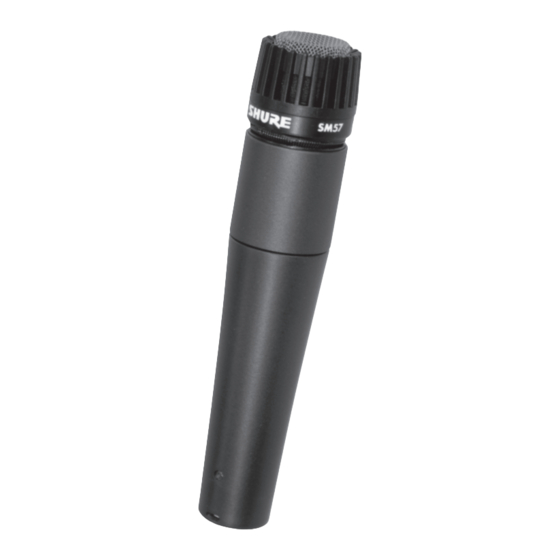
Shure SM57 Bedienungsanleitung
Vorschau ausblenden
Andere Handbücher für SM57:
- Bedienungsanleitung ,
- Handbuch (13 Seiten) ,
- Bedienungsanleitung (16 Seiten)
Inhaltsverzeichnis
Verfügbare Sprachen
Verfügbare Sprachen
Quicklinks
MODEL SM57
UNIDIRECTIONAL DYNAMIC MICROPHONE
The
Shure
SM57
unidirectional
exceptional for musical instrument pickup or for vocals. With its
bright, clean sound and carefully contoured presence rise, the
SM57 is ideal for live sound reinforcement and recording. It has an
extremely effective cardioid pickup pattern which isolates the main
sound source while minimizing background noise. In the studio, it
is excellent for recording drums, guitar, and woodwinds. For
musical instruments or vocals, the SM57 is a consistent choice of
professional performers.
Features
• Frequency response tailored for drums, guitars, and vocals
• Uniform cardioid pickup pattern isolates the main sound source
while reducing background noise
• Pneumatic shock-mount system cuts down handling noise
• Extremely durable under the heaviest use
• Supplied break-resistant swivel adapter that rotates 180°
• Legendary Shure quality, ruggedness, and reliability
STAGE MONITOR & P.A. LOUDSPEAKER PLACEMENT
Place the stage monitor directly behind the microphone (see
Figure 1). Locate the P.A. loudspeakers so that they point away
from the rear of the microphone. With the speakers located in
these positions, the possibility of feedback is greatly reduced.
Always check the stage setup before a performance to ensure
optimum placement.
STAGE
MONITOR
P.A.
LOUDSPEAKERS
RECOMMENDED LOUDSPEAKER PLACEMENT
APPLICATION AND PLACEMENT
Some of the most common applications and placement techniques
for the SM57 are listed in the following table. Remember that mi-
crophone technique is largely a matter of personal taste-there is no
single "correct" microphone position.
2006, Shure Incorporated
©
27C2903 (Rev. 5)
dynamic
microphone
°
90
°
180
MICROPHONE
°
90
FIGURE 1
APPLICATION
Tom-Toms
Snare Drum
is
Guitar & Bass
Amplifiers
Brass & Wood-
winds
Vocals &
Speech
PROXIMITY EFFECT
When the sound source is less than 6 mm (1/4 in.) from the
microphone, the microphone boosts bass frequencies (by 6 to 10
dB at 100 Hz), creating a warmer and richer bass sound than when
farther away. This effect, known as proximity effect, happens in
unidirectional
low-frequency roll-off provides greater control, allowing the user to
take full advantage of proximity effect.
GENERAL RULES FOR MICROPHONE USE
1. Aim the microphone toward the desired sound source and
away from unwanted sources.
2. Locate the microphone as close as practical to the desired
sound source.
°
0
3. Work close to the microphone for extra bass response.
4. Use only one microphone per sound source.
5. Locate multiple microphones at least three times as far from
other microphones as from the sound source.
SOUND
SOURCE
6. Use as few microphones as practical.
7. Place microphones away from sound reflecting surfaces.
8. Add a windscreen when using the microphone outdoors, for
closeup speech, or vocals.
9. Avoid excessive handling to minimize mechanical noise.
Model SM57 User Guide
SUGGESTED MICROPHONE
PLACEMENT
One SM57 on each tom, or between
each pair of toms, 25 mm (1 in.) to
75 mm (3 in.) above the heads. Aim
each mic at the top heads.
On double head toms, remove the
bottom head and place a mic inside
aimed at the head.
25 mm (1 in.) to 75 mm (3 in.) above
the rim of the top head of the drum.
Aim the mic at the head.
If desired, place a second mic just
below the rim of the bottom head.
25 mm (1 in.) from the speaker,
on-axis with the speaker cone.
150 mm (6 in.) to 300 mm (12 in.)
away from speaker and on-axis with
speaker cone.
.5 m (18 in.) to 1 m (3 ft) back from
the speaker, on-axis with the speak-
er cone.
On-axis with the edge of the speak-
er cone.
Brass:.3 m (1 ft) to 1 m (3 ft) away,
on-axis with bell of instrument.
Woodwinds: 25 mm (1 in.) to 150
mm (6 in.) away, on-axis with bell of
instrument.
Bell of the instrument 90° off-axis
from the front of the mic.
25 mm (1 in.) to 150 mm (6 in.) from
the vocalist's mouth.
microphones
like
the
TONE QUALITY
Medium attack,
balanced sound.
Medium attack, bal-
anced sound.
Most "snap" from
drumstick impact
More "snare"
sound.
Most attack,
emphasized bass
Medium attack, full,
balanced sound
Softer attack, thin,
reduced bass
sound.
Thinner, reduced
bass sound.
Bright, clear sound.
Bright, clear sound.
Softer, mellow
sound.
Rich, warm sound.
SM57.
The
SM57
Printed in U.S.A.
Inhaltsverzeichnis

Verwandte Anleitungen für Shure SM57


Inhaltszusammenfassung für Shure SM57
-
Seite 5: Aufstellung Der Bühnenlautsprecher Und Lautsprecher Für Beschallungsanlage
Holzblasinstrumenten einsetzen. Sei es für Musikinstrumente oder 2,5 bis 7,5 cm über dem Rand Stärkster “knalli- Gesang - Profis entscheiden sich immer wieder für das SM57. des oberen Trommelfells. Das ger” vom Auf- Mikrophon auf das Fell richten. -
Seite 6: Spezifikationen
Positiver Druck auf die Membran erzeugt positive Spannung Weitere Informationen über Service oder Ersatzteile erhalten Sie an Stift 2 gegenüber Stift 3 (Abbildung 4). von der Shure Kundendienstabteilung unter der Telefonnummer 1- 800-516-2525. Außerhalb der Vereinigten Staaten wenden Sie sich bitte an Ihr Shure Vertragskundendienstzentrum. -
Seite 17: Anwendung Und Aufstellung
STÄNDER danz. Der integrierte Ständeradapter weist ein dynamisches Ver- • Bewährte Shure Qualität und Zuverlässigkeit . schlußsystem auf, das ein Verstellen der Mikrofonposition er- ANWENDUNG UND AUFSTELLUNG laubt, jedoch bei Auftreffen von Trommelschlegeln ein Verrutschen verhindert. Zur Montage des BETA 52A auf einen Stander und Die gebräuchlichsten Anwendungen und Aufstellungsverfahren für... -
Seite 18: Zertifizierung
Sie von der Shure–Kundendienstabteilung unter der ABBILDUNG 2 Rufnummer 1–800–516–2525. Außerhalb der Vereinigten Staaten Ausgangspegel (bei 1000 Hz) wenden Sie sich bitte an Ihr zuständiges Shure–Kundendienst- Leerlaufspannung: –64 dBV/Pa* (0,6 mV) zentrum. *1 Pa = 94 dB SPL0 dB = 1 V/.Bar Impedanz Die Nennimpedanz für den Anschluß... -
Seite 21: Caratteristiche
Attacco nitido, massima dalla battitoia, leggermen- intensità dei toni bassi, Il modello BETA 52 A della Shure è un microfono dinamico ad ® te fuori asse rispetto alla massimo livello di pressio- uscita elevata con risposta in frequenza adattata specificamente battitoia stessa.