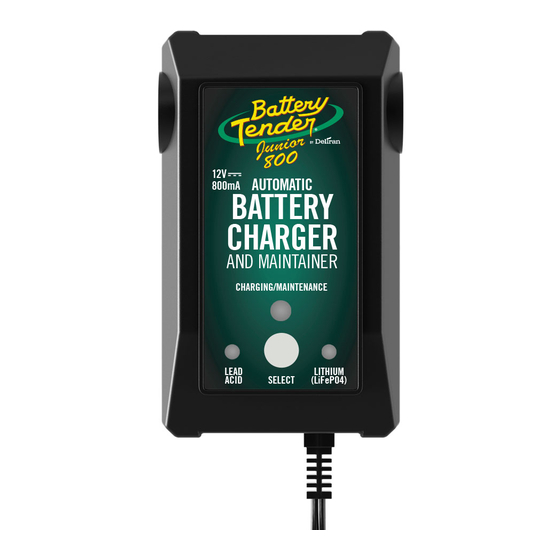
Deltran Battery Tender 800 Selectable Junior Bedienungsanleitung
Konzipiert für blei-säure/agm/zellen-lithium-eisenphosphat- (lifepo4) batterien mit sechs zellen und einer kapazität 20ah
Inhaltsverzeichnis
Verfügbare Sprachen
Verfügbare Sprachen
Deltran Battery Tender
Three cell Lithium Iron Phosphate (LiFePO4) Batteries
Designed for Six cell 20Ah Lead-Acid/AGM &
Three cell Lithium Iron Phosphate (LiFePO4) Batteries
IMPORTANT SAFETY INSTRUCTIONS
1)
SAVE THESE INSTRUCTIONS – This manual contains important safety and operating
instructions for battery charger model P/N 022-0199.
2)
Do not expose charger to rain or snow.
3)
Use of an attachment not recommended or sold by the battery charger manufacturer may
result in a risk of fire, electric shock, or injury to persons.
4)
To reduce risk of damage to electric plug and cord, pull by plug rather than cord when
disconnecting charger.
5)
An extension cord should not be used unless absolutely necessary. Use of improper
extension cord could result in a risk of fire and electric shock. If an extension cord must be
used, make sure:
a)
That pins on plug of extension cord are the same number, size, and shape as those
of plug on charger;
b)
That extension cord is properly wired and in good electrical condition; and
c)
That wire size is large enough for ac ampere rating of charger as specified in Table 1
TABLE 1
Length of Cord, Feet
AWG Size of Cord
6)
Do not operate charger with damaged cord or plug – replace the cord or plug immediately.
7)
Do not operate charger if it has received a sharp blow, been dropped, or otherwise
damaged in any way; take it to a qualified serviceman.
8)
Do not disassemble charger; take it to a qualified serviceman when service or repair is
required. Incorrect reassembly may result in a risk of electric shock or fire.
9)
To reduce risk of electric shock, unplug charger from outlet before attempting any
maintenance or cleaning. Turning off controls will not reduce this risk.
10) WARNING – RISK OF EXPLOSIVE GASES.
a)
WORKING IN VICINITY OF A BATTERY IS DANGEROUS. BATTERIES GENERATE
EXPLOSIVE GASES DURING NORMAL BATTERY OPERATION. FOR THIS
REASON, IT IS OF UTMOST IMPORTANCE THAT YOU FOLLOW THE
INSTRUCTIONS EACH TIME YOU USE THE CHARGER.
b)
To reduce risk of battery explosion, follow these instructions and those published by
battery manufacturer and manufacturer of any equipment you intend to use in vicinity
of battery. Review cautionary marking on these products and on engine.
11) PERSONAL PRECAUTIONS
a)
Consider having someone close enough by to come to your aid when you work near a
battery.
b)
Have plenty of fresh water and soap nearby in case battery acid contacts skin,
clothing, or eyes.
Selectable
NORTH AMERICAN MODELS ONLY
Designed for Six cell Lead-Acid/AGM &
For FOREIGN COMPLIANCE
25
50
100
150
18
18
18
16
P/N 392-0311-RB
1
c)
Wear complete eye protection and clothing protection. Avoid touching eyes while
working near battery.
d)
If battery acid contacts skin or clothing, wash immediately with soap and water. If acid
enters eye, immediately flood eye with running cold water for at least 10 minutes and
get medical attention immediately.
e)
NEVER smoke or allow a spark or flame in vicinity of battery or engine.
f)
Be extra cautious to reduce risk of dropping a metal tool onto battery. It might spark or
short-circuit battery or other electrical part that may cause explosion.
g)
Remove personal metal items such as rings, bracelets, necklaces, and watches when
working with a battery. A battery can produce a short-circuit current high enough to
weld a ring or the like to metal, causing a severe burn.
h)
Use charger for charging a Lead-Acid/AGM/Lithium Iron Phosphate (LiFePO4)
battery only. It is not intended to supply power to a low voltage electrical system other
than in a starter-motor application. Do not use battery charger for charging dry-cell
batteries that are commonly used with home appliances. These batteries may burst
and cause injury to persons and damage to property.
i)
NEVER charge a frozen battery.
12) PREPARING TO CHARGE
a)
If necessary to remove battery from vehicle to charge, always remove grounded
terminal from battery first. Make sure all accessories in the vehicle are off, so as not
to cause an arc.
b)
Be sure area around battery is well ventilated while battery is being charged.
c)
Clean battery terminals. Be careful to keep corrosion from coming in contact with
eyes.
d)
Add distilled water in each cell until battery acid reaches level specified by battery
manufacturer. Do not overfill. For a battery without removable cell caps, such as valve
regulated lead acid batteries, carefully follow manufacturer's recharging instructions.
e)
Study all battery manufacturers specific precautions such as removing or not
removing cell caps while charging and recommended rates of charge.
f)
Determine voltage of battery by referring to car owner's manual and make sure that
output voltage selector switch is set at correct voltage. Do not use the battery charger
unless battery voltage matches the output voltage rating of the charger.
13) CHARGER LOCATION
a)
Locate charger as far away from battery as dc cables permit.
b)
Never place charger directly above battery being charged; gases from battery will
corrode and damage charger.
c)
Never allow battery acid to drip on charger when reading electrolyte specific gravity or
filling battery.
d)
Do not operate charger in a closed-in area or restrict ventilation in any way.
e)
Do not set a battery on top of charger.
14) DC CONNECTION PRECAUTIONS
a)
Connect and disconnect dc output clips only after setting any charger switches to
offposition and removing ac cord from electric outlet. Never allow clips to touch
each other.
b)
Attach clips to battery and chassis as indicated in 15(e), 15(f), and 16(b) through
16(d).
15) FOLLOW THESE STEPS WHEN BATTERY IS INSTALLED IN VEHICLE. A SPARK
NEAR BATTERY MAY CAUSE BATTERY EXPLOSION. TO REDUCE RISK OF A
SPARK NEAR BATTERY:
a)
Position ac and dc cords to reduce risk of damage by hood, door, or moving engine
part.
b)
Stay clear of fan blades, belts, pulleys, and other parts that can cause injury to
persons.
c)
Check polarity of battery posts. POSITIVE (POS, P, +) battery post usually has larger
diameter than NEGATIVE (NEG, N,–) post.
d)
Determine which post of battery is grounded (connected) to the chassis. If negative
post is grounded to chassis (as in most vehicles), see (e). If positive post is grounded
to the chassis, see (f).
2
Inhaltsverzeichnis
Fehlerbehebung

Verwandte Anleitungen für Deltran Battery Tender 800 Selectable Junior

Inhaltszusammenfassung für Deltran Battery Tender 800 Selectable Junior
-
Seite 11: Dépannage
Deltran Battery Tender TÉMOIN LUMINEUX VERT CLIGNOTANT (Témoin lumineux à DEL vert 1) – Lorsque le témoin lumineux vert clignote, le niveau 800 Selectable Junior de charge de la batterie est supérieur à 80 %. La batterie peut être Konzipiert für Blei-Säure/AGM/Zellen-Lithium-Eisen-... - Seite 12 Sollte Batteriesäure auf Ihre Haut oder Kleidung gelangen, waschen Sie sie 15) FOLGEN SIE DIESEN SCHRITTEN, FALLS SICH DIE BATTERIE IM FAHRZEUG unverzüglich mit Seife und Wasser. Sollte Batteriesäure in Ihre Augen gelangen, BEFINDET. EIN FUNKEN IN DER NÄHE DER BATTERIE KANN ZU EINER spülen Sie Ihre Augen unter fließendem kalten Wasser für mindestens 10 Minuten EXPLOSION FÜHREN.
- Seite 13 Das Netzkabel kann nicht ersetzt werden. Ein Gerät mit beschädigtem Statusanzeige (1) für den Lade-/Wartungszustand auf durchgängig Grün Netzkabel sollte ausrangiert werden. und das Ladegerät schaltet in den Lagerungs/-Float-Ladungs-Modus um. Untersuchen Sie das Ladegerät, insbesondere das Kabel, den Stecker und Eine vollständig aufgeladene Batterie wird automatisch vom Battery das Gehäuse, regelmäßig auf Schäden.
-
Seite 14: Fehlerbehebung
Stromquelle verbunden ist, keine Verbindung der Krokodil- oder Hinweis: Ringklemmen mit einer Batterie besteht und sich die Klemmen berühren. Siehe Seite 26 für die Lichtabfolge des Recovery-Modus für Lithium-Eisen- Phosphat-Batterien. HINWEIS: DAUER DES LADEVORGANGS: DIE ABGEHENDEN KLEMMEN ODER RINGKLEMMEN MÜSSEN MIT EINER ®...